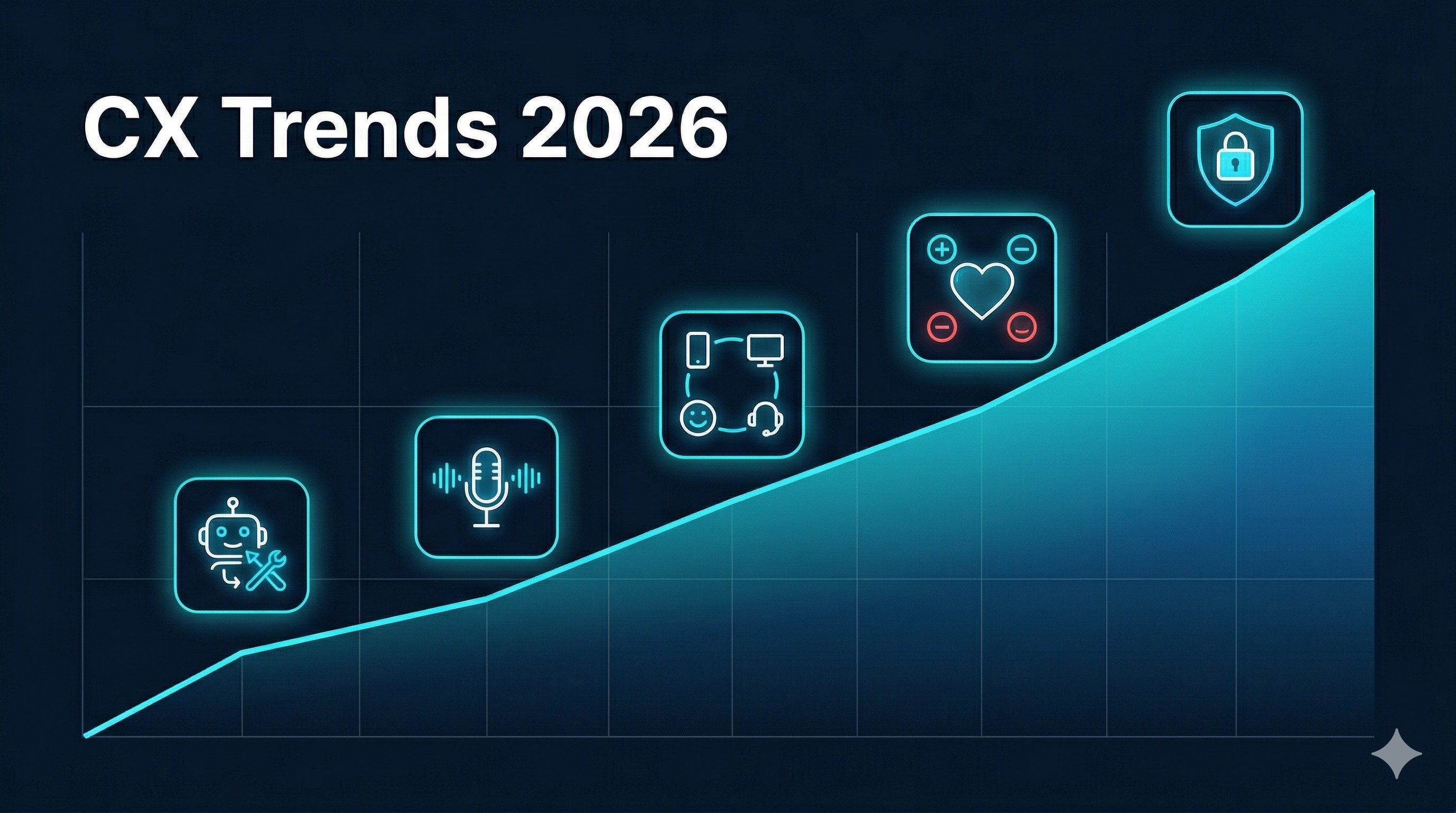
Key Takeaways
- AI-powered personalization is no longer optional — brands using AI in CX see up to 40% higher revenue from personalization activities.
- Real-time feedback loops are replacing annual surveys; leading companies now collect and act on customer signals within hours, not months.
- 73% of customers use multiple channels during a single purchase journey, making omnichannel consistency the new baseline expectation.
- Emotional AI goes far beyond positive/negative classification — detecting frustration, delight, urgency, and loyalty signals at scale.
- Privacy-first data strategies are turning GDPR and KVKK compliance into a competitive advantage, with data trust directly influencing purchase decisions.
Blog
Customer Experience Trends 2026: What the Data Tells Us
Customer experience has never moved faster. In 2026, the gap between brands that understand their customers in real time and those still relying on annual surveys is becoming a chasm too wide to cross.
Five macro-shifts are redefining what CX leadership looks like — and each one presents both a challenge and an opportunity for organizations willing to act on the data.
1. AI-Driven Personalization at Scale
AI is transforming how brands understand and engage with individual customers. Rather than grouping customers into broad segments, AI enables hyper-personalization at scale — tailoring offers, communications, and service interactions to each individual's unique history, preferences, and predicted needs. According to McKinsey, companies that excel at personalization generate 40% more revenue from those activities than average players.
What sets 2026 apart is the democratization of AI-powered CX tools. Previously reserved for enterprise giants with massive data science teams, AI personalization is now accessible to mid-market companies. The shift from rule-based segmentation to model-driven hyper-personalization is perhaps the most impactful structural change in CX strategy this decade. Platforms like VoC leverage machine learning across thousands of customer interactions, enabling brands to anticipate needs rather than simply react to them.
2. Real-Time Listening Replaces Periodic Surveys
Gone are the days of the annual customer satisfaction survey. In 2026, leading brands are moving to continuous listening architectures — systems that capture, analyze, and act on customer signals in near real time. Gartner predicts that by 2026, 60% of organizations with formal CX programs will complement traditional surveys with real-time interaction monitoring.
The shift matters because customer emotions and expectations change fast. A product issue discovered within 24 hours can be addressed before it becomes a public crisis. Real-time dashboards give CX teams visibility into emerging patterns — whether it's a spike in contact center complaints, a drop in NPS after a service update, or a surge of negative social sentiment following a campaign launch. Speed of insight is now a competitive moat.
3. Omnichannel Experience Becomes Non-Negotiable
Research by Harvard Business Review found that 73% of shoppers use multiple channels during a single purchase journey. In 2026, the question is no longer "should we have an omnichannel strategy?" — it's "how seamlessly can we deliver it?" Customers expect to start a service interaction on social media, continue via chat, and resolve it by phone — without ever repeating themselves.
Unified experience measurement is the foundation of omnichannel success. Integrating signals from surveys, call centers, mobile apps, and social platforms into a single experience score helps brands identify which touchpoints are breaking the journey. VoC's Social Insight integration brings this unified view to life, allowing teams to prioritize CX investments with the highest measurable impact across all channels simultaneously.
4. Emotional AI & Sentiment Goes Deeper
Traditional sentiment analysis labelled text as positive, negative, or neutral. In 2026, emotional AI goes far deeper — detecting frustration, delight, confusion, urgency, and loyalty signals within the same sentence. This evolution is powered by large language models trained on domain-specific customer conversation data.
A customer who writes "I guess the product works" is technically positive — but the hesitancy signals a very different emotional state than "Absolutely love this product!" Understanding that difference is what separates reactive CX teams from proactive ones. Advanced sentiment engines move beyond keyword scoring to understand context and nuance, turning these signals into actionable customer health scores that predict churn and advocacy before they happen.
5. Privacy-First Data: Compliance as Competitive Advantage
With GDPR and Turkey's KVKK fully enforced and enforcement budgets growing, data compliance is no longer just a legal checkbox — it's a market differentiator. Edelman's Trust Barometer consistently shows that 81% of consumers say trust is a deciding factor in their purchasing decisions. Brands that can demonstrate responsible data stewardship are winning customer confidence in ways that advertising cannot replicate.
The most forward-thinking organizations are treating privacy infrastructure as a strategic investment rather than a compliance cost. Offering flexible deployment options — Public Cloud for scalability, Private Cloud for enhanced security, and On-Premises for full data sovereignty — gives regulated industries like banking, healthcare, and public institutions the control they need without sacrificing CX capability. In 2026, privacy-first is not just compliant. It is competitive.
Looking Ahead
2026 is the year customer experience moves from department function to company strategy. Brands that invest in AI personalization, real-time listening, omnichannel coherence, emotional intelligence, and privacy-first design will not just satisfy customers — they will earn the kind of loyalty that survives economic headwinds and competitive disruption.
The question is not whether to act on these trends. It is how quickly you can begin turning them from insight into action.